How come you have no energy for the things you say are important to you?

How come you have no energy for the things you say are important to you?

filling my brain with stuffWhen I look how come I get to accomplish so much in a day, ultimately I always find that I set up my life differently from most.

I started back in 1987…

I was in a seminar called “Excellence” and I was clearly not in excellence in my life. The biggest issue was how much I hated my job, how much I would have preferred to do something else. Anything else.

But that was my job, and I didn’t see any alternative…

So I decided to do what I could… And I decided to pull back my power. Continue reading “How come you have no energy for the things you say are important to you?”

What did you get for yourself for Christmas?

What did you get for yourself for Christmas?


What did you get for yourself for Christmas?

I have been seeing that everyone is trying to make a last sale to spruce up the bottom line. This sale and that deal…

I ponder if the distaste I have for haggling and pitching and forcing people to buy is going to render me, forever on the poor side. Continue reading “What did you get for yourself for Christmas?”

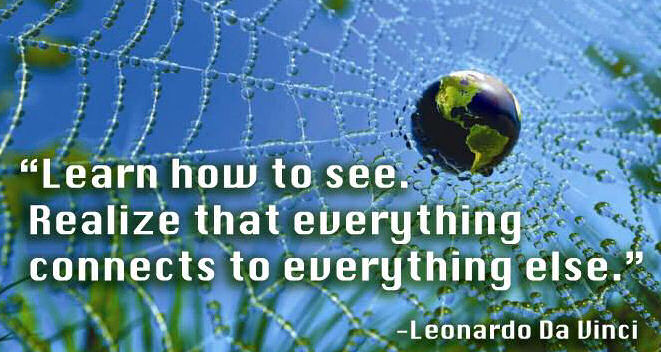
Everything is connected… ok, maybe, but what does that mean to you?!

Everything is connected… ok, maybe, but what does that mean to you?!

Everything is connected. The connection is in the invisible realm, but it is not less real than the visible, it is just either below the surface or its wave length is not in the visible range of light.

The connection can be

  • chemical in nature.
  • It can be vibrational in nature
  • Electric in nature

I’ll give you some examples I am suddenly seeing now that my vibration jumped to 950.
Continue reading “Everything is connected… ok, maybe, but what does that mean to you?!”

Working on the thing you want, directly, is a mistake…

Working on the thing you want, directly, is a mistake…

you are a liarThe same faulty thinking, the same thinking that makes you not do things that don’t directly produce money, or the results you seek, the same thinking that makes you a chef with no food in the pantry, is what keeps your relationships empty, and causes your vibration to remain low.

I was just looking at a post of mine: an Osho talk.

He says: Allow Silence to Grow

It triggered a distaste in my mouth. I published that article and I am suddenly knocking it? WTF, right?

But there is a reason… I have changed. I see things that even just a week ago could not see

I have to confess something: I am reading a book, called “Feelings” and inadvertently it has knocked my vibration up a notch. How? Why? It managed to put me in touch with some feelings I have been protecting myself from.
Continue reading “Working on the thing you want, directly, is a mistake…”

What is the purpose of life?

What is the purpose of life?

what is the purpose of life?I watched a movie last night… actually, it took me two nights to watch. It was a Korean movie, a historical movie. An old hunter and a huge tiger… bound for life by gratitude and tragedy. I am still weeping… I’ll explain.

It is all about the purpose of life… and the purposelessness of life, if you wish.

Your answer will depend on where you’re looking from.

In the movie, once both the hunter and the tiger lost their progeny, their offspring, and their hopes for the survival of their genes ended, they are both ready to die themselves. The purpose of life ended with the loss of their offspring.
Continue reading “What is the purpose of life?”

Cooking Jazz, Not Classical

Cooking Jazz, Not Classical
Lowering the barriers of cooking, so more people can connect deeply with the food system.

Last week we extolled the virtues of cooking and how it’s the link between everyday action and massive food systems change.

In a nutshell, cooking brings us closer to the food system like no other thing can and it makes us all informed, vested partners in a better food future.

But the way we teach mainstream America to cook is broken. It’s a recipe driven system, which prioritizes rote memorization over intelligent kitchen improvisation. It forces us to fit rigidly into a script, instead of staying flexible to the idiosyncrasies of our daily lives and pantries.

If we are to improve the food system through cooking, we need to lower the barriers to cooking and change the way we teach people how to make food.

A few years ago I wrote a piece on my supperclub’s blog about this very topic, which I’m re-posting below. It still encapsulates the way I look at cooking and I hope it can sway some of you away from the tyranny of the recipe and onto the freedom of gaining food instincts. I think it’s a way of looking at food that can get more people cooking regularly.

With all the ways to push a button and make food appear at our doorsteps, we need more ways to lower the barriers to cooking for everyday people.

Here it is, Cooking Jazz, Not Classical…

Over the years we’ve cooked a lot of recipes. Some have called for a battalion of ingredients and some have even begged for certain items to measured within a tenth of a gram. Taken literally, a recipe inherently calls for some semblance of perfection in the kitchen–you have all the ingredients, all the equipment, all the spices, etc.–and depending on whose recipe you’re reading, deviating from the script can be hazardous.

This sort of cooking is fine and well for the situation that calls for it, but more often than not in our lives, we cook in a much looser format. Life isn’t perfect, we aren’t perfect, so why live under the engineered construct of cooking by the recipe, where the ante is usually some level of perfection that most kitchens don’t have?

And while I learned to cook to some extent by following recipes, what stuck with me has not always been the exact composition of a recipe, but the underlying structure that most good recipes follow. The simplest example is pasta. Why do we need 100s of Pasta Primavera recipes? Why do we need 100s of separate units of information to tell us how to make different versions of the same dish structure?

The formula for Pasta Primavera is: 1) Pasta, 2) Vegetable, 3) Meat, if you wish. Why don’t we just tell people the basic structure of Pasta Primavera, tell them the characteristics of each element in the structure (e.g., Pasta: any long pasta works great, don’t use stuffed pastas; Vegetables: sturdy green veggies work best, don’t use potatoes…) and implore them to find the combinations that they like?

I believe that if you pay attention to how a dish is structured, rather than cooking each variation of it one by one in a recipe, you can have a much more fulfilling experience in the kitchen. You will gain intelligence about cooking, not just knowledge, and you will be more adept in the kitchen as a result.

A recipe is written like classical music–you follow the score, and note-by-note on the page, you create music. What I’m proposing is that we all start thinking of cooking more like Jazz–learn the basic scales and the right chords, then go off and jam out.

The Jazz approach brings cooking back down to Earth, embracing our culinary imperfections and whims, not making us feel bad that we don’t fit the rules dictated by a recipe. If we can teach people to become better improvisers in the kitchen, we can lower the barriers to cooking at home, and hopefully create new a new habit for the average American. I believe that we are smarter than the caricatures of chefs (professional and otherwise) that we see on the Food Network, and that we can teach people how to be intelligent in the kitchen, not simply follow orders.
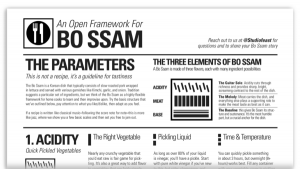

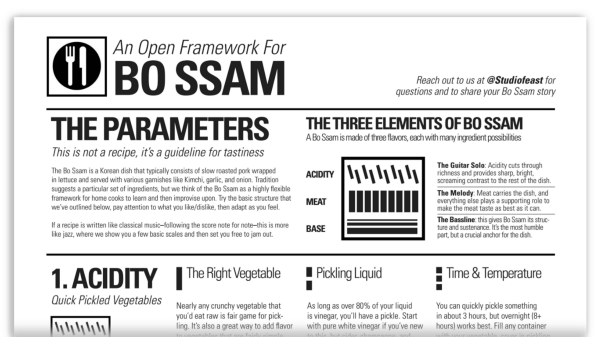
Which brings me to an example that’s near and dear to us at Studiofeast. Here is a structure for Bo Ssam, that carnivorous Korean classic that has sat at the center of many a dinner party for us. In the image, the key elements of a Bo Ssam are unpacked, but we try to give guidelines rather than instructions on how to create your own. It’s an imperfect, initial attempt, but I want to see if it makes sense to people and if it can be the first step toward getting people to approach cooking a different way. This is the start, and it will evolve.

Go on, download the Bo Ssam Framework here and try it on your own.

Source: https://medium.com/the-future-market/cooking-jazz-not-classical-490eb9b77d8#.pjxql3r17
What will it take to steer your life to the good life?

What will it take to steer your life to the good life?

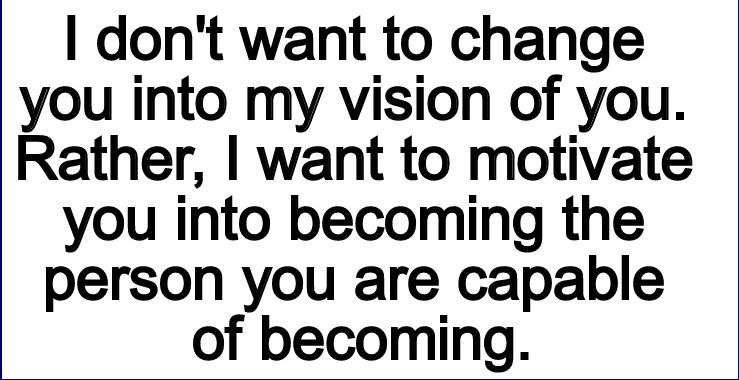
I don’t want to change you into my vision of you. Rather, I want to motivate you into becoming the person you are capable of becoming.

– Life Mapping (Bill Cohen)

Display and existence. These are two Landmark Education distinctions.

As I am looking at my students, the biggest missing is not intelligence, not diligence, it is these two distinctions. Continue reading “What will it take to steer your life to the good life?”

The crash and burn style of life… are you guilty of it?

The crash and burn style of life… are you guilty of it?

The hardest thing for people is to find the middle ground, the sustainable, the mean. The smooth. The life they claim they want. Everyone, on and off the internet, is trying to monopolize your time.

It is a lot like walking on a rope… any movement, leaning to the left immediately needs to be balanced to the right.

In rope dancing the consequences are clear and immediate.

In plate spinning: the consequences are clear and immediate.

In life, even in business, the consequences are removed, timewise, and unless you are astute with a very wide cone of vision, you don’t know what you are causing with each and every movement you make…

No movement is also a movement, by the way.


Continue reading “The crash and burn style of life… are you guilty of it?”

Change… The hardest thing. Why? Do you really want to change? I didn’t think so.

Change… The hardest thing. Why? Do you really want to change? I didn’t think so.

If you wanted to change… if you actually wanted to change… so your life can change too… where would you make the change?

I just had a conversation with one of my students who shows promise to be able to change.

The conversation was about how to behave, what to do when you notice mistakes, mistakes YOU make.
 

Mistakes are like the fruit on the fruit bearing tree. Symptoms. Show what kind of tree you have…

On a side note: where do I look when I assess who will change and who will not?

I will look at two places:

  • 1. do they argue or offer explanations or excuses when they get feedback from me. Argument, explanations, and excuses are the sign of a foolish person who won’t take feedback, and either won’t change, or will do it to either curry approval from you, or to prove you wrong.
  • 2. An immediate testing tool is the 5-question exercise. If they do it, that is a very good sign that they will be willing to change.

Continue reading “Change… The hardest thing. Why? Do you really want to change? I didn’t think so.”

Your weirdness factor. How weird are you… or not

Your weirdness factor. How weird are you… or not

Weirdness Factor

One of Tai’s steps talks about the weirdness factor, your weirdness factor.

Only one student whose mother tongue is not English interpreted weirdness correctly.

What the f… right? Compared to what?!

You think that you know English. But your English is a personal English… what you mean is not expressed by the words you use accurately, and what you read is not what the writer of a sentence meant.

So you see, with words being such a flimsy, unreliable vehicle for thinking and communicating, the world cannot be a better place.

The troubles in your life cannot be fixed with the language that created them. 1

Continue reading “Your weirdness factor. How weird are you… or not”

This website stores cookies on your computer. These cookies are used to provide a more personalized experience and to track your whereabouts around our website in compliance with the European General Data Protection Regulation. If you decide to to opt-out of any future tracking, a cookie will be setup in your browser to remember this choice for one year.

Accept or Deny